August 21, 2026
Expert Forum at DBFZ “Investments in Low-Carbon Technologies – Focus on Process Heat”
30 June 2026 at the German Biomass Research Centre (DBFZ), Leipzig, Germany.
Extreme weather events, heatwaves and increasing climate-related damage are making one thing increasingly clear: climate change is not an abstract challenge of the future. The transition towards a climate-neutral economy is already a key task for policymakers, society and businesses alike.
With the Paris Agreement, the international community committed to keeping the increase in global average temperature well below 2°C and pursuing efforts to limit it to 1.5°C above pre-industrial levels. For the European Union, this means reducing net greenhouse gas emissions by at least 55% by 2030 compared with 1990 levels and achieving climate neutrality by 2050. Germany is pursuing an even more ambitious target: greenhouse gas neutrality by 2045.
But how can this transformation be achieved in practice?
This question was the focus of the expert forum ‘Investments in Low-Carbon Technologies – A Focus on Process Heat’, which took place on 30 June 2026 at the German Biomass Research Centre (DBFZ) in Leipzig. Experts from the fields of science, the energy sector and industry discussed current developments, technological solutions and key prerequisites for successful transformation strategies within companies.
Industry remains a key driver of decarbonization
A look at energy consumption and emissions shows why the industrial sector plays a key role. According to the data presented at the expert forum, industry accounted for around 28% of Germany’s final energy consumption in 2023. At the same time, it was responsible for around 24 % of greenhouse gas (GHG) emissions. Overall, Germany’s final energy consumption stood at around 2,268 TWh, whilst emissions amounted to around 649 million tons of CO₂ equivalents.
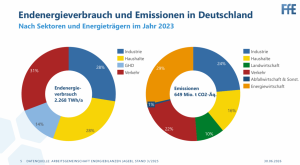
Figure: Dr. Anna Gruber/FfE, “From individual measures to a transformation strategy: what businesses need now”
This makes it clear that anyone wishing to achieve climate targets must consistently drive forward the transformation of industrial processes, and in particular the use of process heat. However, there is no single path to reducing CO₂ emissions. Emissions can be reduced through various measures: by lowering energy and resource consumption, improving energy efficiency, replacing fossil fuels, direct or indirect electrification, renewable heat, green fuels or CO₂ capture.
For businesses, this means above all that decarbonization should not be viewed as a one-off investment decision, but as a long-term transformation strategy.
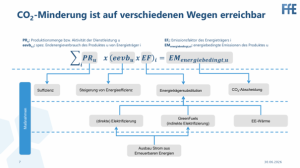
Figure: Dr. Anna Gruber/FfE, “From individual measures to a transformation strategy: what businesses need now”
Efficiency first: The first step often lies in the existing process
Before introducing new energy sources or complex technologies, it is worth taking a look at current energy consumption first. Energy efficiency measures can immediately reduce energy demand whilst improving the cost-effectiveness of subsequent decarbonization steps.
In industrial companies in particular, process optimisation, waste heat utilisation, heat recovery or systematic energy management can be important first steps. They create a better foundation for planning further investments in low-carbon technologies in a way that makes technical and economic sense.
Funding opportunities for energy efficiency measures
Investments in energy and resource efficiency can be supported by public funding programmes. The Federal Funding Programme for Energy and Resource Efficiency in Industry (EEW) offers companies various funding opportunities for measures to increase energy and resource efficiency.
Process heat: Temperature determines the technology
A question of particular relevance to industry is how fossil-fuel-based process heat can be replaced. The appropriate solution depends heavily on the specific temperature level and production process.
Various electric solutions are already available today for low- and medium-temperature processes, including heat pumps, electric boilers and electrode boilers. Heat requirements below 150 °C can often already be effectively met using electricity. By contrast, processes between 150 and 500 °C – and particularly those above 500 °C – usually require more nuanced, process-specific approaches.
The crucial question is therefore not: Which technology is the best?
But rather: Which combination of technologies makes technical and economic sense for the specific site, process and transition pathway?
New funding opportunity for industrial process heat: IF26 Heat Auction
The IF26 Heat Auction is a new funding instrument from the EU Innovation Fund aimed at decarbonizing industrial process heat. The call, which has a budget of €1 billion, is designed to support investment in low-carbon heating solutions and is expected to launch in December 2026.
Electrification and renewable energy: momentum meets new system limits
Electrification is one of the key trends in the energy transition. At the same time, the expansion of renewable energy is growing rapidly worldwide, particularly in the case of wind and solar photovoltaic installations. Innovation is a key driver of this development.
Despite this growth, the challenges remain significant. Conventional energy sources still account for a very high proportion of the energy supply in Germany and worldwide. Whilst the expansion of renewable energy is progressing, the analyses presented at the expert forum indicate that it is not yet sufficient to meet climate targets.
At the same time, the increasing electrification of industry, transport and heating is driving up the demand for high-capacity grids, storage facilities and flexible consumption patterns. As wind and solar power are weather-dependent, flexibility options such as grid and storage expansion, as well as demand-side management, are becoming increasingly important.
EU Electrification Action Plan: Further accelerating electrification
With the Electrification Action Plan published in July 2026, the European Commission aims to significantly accelerate direct electrification in Europe. The action plan also addresses key prerequisites for industrial transformation, ranging from competitive electricity prices and high-performance grids to the faster roll-out of innovative electrification solutions.
Grid connections as a strategic factor
For industrial companies, it is not just the choice of the right technology that is crucial. The availability of grid connection capacity is also becoming a strategic factor. In this context, the FfE pointedly described grid connections as ‘the new gold’.
From a funding perspective, too, clarifying grid connection arrangements at an early stage is becoming increasingly important. A lack of grid capacity, or capacity that is only available in the long term, can significantly affect the technical feasibility and timetable of a decarbonization project and, consequently, the assessment of the project’s readiness within the context of a funding application.
In future, decisions on the energy transition must take greater account of which energy sources will be available at the site in the long term, what grid capacities exist, how flexibly production processes can be operated, and which investments are economically viable.
A purely technological decision is thus increasingly becoming a combined strategy encompassing technology, energy, infrastructure and investment.
Innovation and support as the key to industrial transformation
Many of the technologies needed for the transition already exist. Others are still progressing from pilot and demonstration projects towards industrial-scale deployment. This transition is particularly critical.
New technologies must not only work from a technical perspective. They must be scalable, economically viable and capable of being integrated into existing industrial processes. At the same time, the investments required are often substantial and associated with technological, regulatory or market-related risks.
This is where European and national funding programmes play an important role. Instruments such as the EU Innovation Fund, the LIFE Programme and other funding opportunities at European and national level can support companies in demonstrating and scaling innovative decarbonization technologies and bringing them to market more quickly.
Funding is not a substitute for a transformation strategy. However, it can help reduce investment risks and make innovative projects economically viable at an earlier stage.
From PNO’s perspective, the Expert Forum once again highlighted that industrial decarbonization is not a matter of individual measures, but rather a complex transformation process. Companies need to consider technical options, economic feasibility, regulatory requirements, infrastructure needs and financing opportunities together.
This is precisely where PNO Innovation supports companies: from identifying suitable funding programmes and developing robust project concepts to preparing funding applications for innovative industrial and decarbonization projects.
As experts in innovation and public funding, we support companies in turning technological ideas into viable, fundable and implementable projects, helping them actively contribute to the transition towards a climate-neutral industry.
Quelle: PNO Innovation GmbH
